Tuesday, October 21, 2014

How to Store Sweet Potatoes

Sweet potatoes can last for several months when stored properly, but you need to follow proper storage procedures carefully in order to prevent them from bruising or spoiling. Here's what you need to know about storing sweet potatoes at both room temperature and freezing temperatures.

1. Use fresh, fat sweet potatoes. Newly harvested sweet potatoes with the roots still attached are the best option to use.
Plump sweet potatoes store just as well as skinny ones, and they have more usable "meat" to consume.
If harvesting the sweet potatoes yourself, use a spade fork to dig 4 to 6 inches (10 to 15 cm) beneath the soil in order to get all the roots up. Handle them carefully since sweet potatoes tend to bruise easily, and shake off excess dirt but do not wash the roots.

2. Cure the sweet potatoes for 1 to 2 weeks. Keep the roots in a room or other location that reaches between 75 and 80 degrees Fahrenheit (24 and 27 degrees Celsius) with relative humidity of 90 to 95 percent.
The sweet potatoes need to cure for at least 7 days, but they can be kept there for as many as 14 days.
The curing process creates a second skin that forms over scratches and bruises, allowing the sweet potatoes to last longer in storage.
Use a small electric fan in the area to keep the air circulating. This helps to prevent rotting and molding.
Monitor the temperature and humidity regularly to make sure that the sweet potatoes are sitting in the conditions needed for proper curing.
For best results, keep the sweet potatoes from touching each other as they cure.

3. Discard bruised sweet potatoes. After the sweet potatoes have finished curing, throw away any that appear bruised, rotting, or moldy.
Bruised sweet potatoes have not cured correctly, so they will not last as long as the other sweet potatoes and may even cause the other sweet potatoes to spoil faster.

4. Wrap each one in newspaper. Individually wrap the sweet potatoes in sheets of newsprint or in brown paper bags.
Newspaper and brown paper bags are both fairly breathable, providing just enough air circulation to prevent the sweet potatoes from rotting too quickly.

5. Pack the sweet potatoes in a box or basket. Store the individually-wrapped sweet potatoes in a cardboard box, wooden box, or wooden basket.
Do not use an airtight storage container.
Place an apple in the box.The apple will help prevent the sweet potatoes from budding.

6. Store in a cool, dark location. Keep the sweet potatoes in an area that is consistently between 55 and 60 degrees Fahrenheit (13 and 16 degrees Celsius).
For best results, store the sweet potatoes in a basement or root cellar. If neither option is available to you, store them in a dark, cool, and well-ventilated cupboard or pantry away from strong heat sources.
Do not use a refrigerator.
Monitor the temperature frequently to make sure that it does not fall below or rise above this range.
Stored in this manner, the sweet potatoes can last up to 6 months. Remove them from storage gently to prevent bruising.

Thursday, September 18, 2014

Top 10 apples to grow in your garden


1. 'Chivers Delight'

This is a late flowerer and cropper referred to in the trade as a 'Cox Plus'. It has as much flavour (if not more) than 'Cox's Orange Pippin' and better acidity, which it keeps in storage. Cox famously go woolly quickly in storage, whereas the flesh of 'Chivers Delight' remains firm and nutty. This fell out of commercial favour because of its colour irregularity. If the sun is on it, the fruit goes red, but it will not colour up on the shady side. This does not affect the flavour but makes them difficult to sell.

2. 'Spartan'

Nothing has the same richness of colour as 'Spartan', a lovely deep plum red, with almost bright white, contrasting flesh. It's a beautiful apple, which stays late on the tree and makes a fabulous eater with very juicy fruit. It's the one I use at Perch Hill for Christmas wreaths and, being a good storer, is widely available late in the year.

3. 'Blenheim Orange'

A fabulously aromatic, peppery, almost spicy apple with a softer nuttiness than you get with the similar-flavoured 'Egremont Russet'. This variety is a bit prone to scab, so is best grown on its own and certainly away from very scab-prone varieties such as 'Crispin'.

4. 'Egremont Russet'

A famous apple with a wonderful nutty, woody texture and a very characteristic taste, floral and heady, so you can almost smell the blossom. It stores well, with the flavour deepening to honey.

5. 'Pitmaston Pine Apple'

This is a very unusual apple, difficult to find but, in Henry's view, worth the effort. It eats like a 'Greensleeves' early on, but you can store it until April when the flavour morphs into pineapple.

6. 'Greensleeves'

A light, crispy, full-of-flavour apple, lovely and crunchy straight off the tree. This is the one 'Golden Delicious' aspires to be, with excellent flavour in a beautiful pale yellow fruit.

7. 'Discovery'

This is one of the first to harvest (in August), so Henry loves it for reminding us what we've been missing all summer. If we get a sunny July and August, the redness leaches from the skin into the flesh. Then if you press it, you'll have a beautiful pale pink juice.

8. 'Worcester Pearmain'

A rich, creamy apple with a really strong flavour, one of the original varieties brought over by the Normans. It's just about surviving in the UK, but you don't see it often, apart from in the Wye Valley where it's usually pressed into juice.

9. 'Howgate Wonder'

A great all-rounder apple – a good cooker early on, it also presses well and mellows the later you leave it, with the acidity dropping away, so it can be eaten as a dessert apple from the store or tree. It's one of the few varieties where you can leave the fruit on the tree, start harvesting in August and carry on until the end of October at least. It performs well whatever the weather and is often a challenger for the largest fruit.

10. 'Médaille d'Or'

Monday, June 16, 2014

How to Microchip Your Goat for Easy Identification

If you live in a state that doesn't require identification, you don't have to permanently identify unregistered goats. If you get a registered goat, it should already have a microchip or tattoo, and if you want to register a goat that is eligible for one of the registries, you will be required to permanently identify it to prove that the goat is who you say it is. You also may want to permanently identify your goats even if you aren't required to. You never know when you might have to prove that they're yours — if they get lost or stolen, for example.


Microchips come in sterile, individual injectors that look like a large syringe and needle. Each is sealed, has a unique number, and includes several stick-on labels imprinted with the number. The microchips can be read only with a special microchip reader.

The best place to insert the microchip is in the tail web (the loose, hairless area under the tail on either side of the anus). Always use the left side to make finding the microchip easier.

You need a cotton ball, some rubbing alcohol, a microchip in its injector, a microchip reader, and registration papers and/or another form to record the number. (A reader is not required for microchipping, but by having one, you avoid the small chance of error in recording the number.)

Here are the steps you take to microchip your goat:

Get your supplies together.

Remove the microchip injector from its container, being careful to keep the needle up so the chip doesn't fall out, and scan it. Confirm that the number scanned is identical to the number on the stick-on labels.

Secure the goat on a milk stand or have a helper hold the goat on her lap.

If you're using a helper, have her hold the goat with the head to one side, the legs secured between her legs, and her arm wrapped around the goat's side holding the tail up. She can hold the legs with the other hand for more stability.

Clean the insertion area with alcohol.

If you have a goat that may have been microchipped previously, scan the area several times to verify that no chip is implanted.

Insert the needle just under the loose skin for several inches, pressing upward at a nearly parallel angle.

Press the plunger until it stops.

Remove the needle and apply pressure for a few minutes at the injection site to prevent the microchip from coming out and to stop any bleeding.

Scan to locate the implanted microchip.

Verify the number against the stick-on labels. Place a label on your form and registration papers, if applicable, and record the animal's name.

Wednesday, May 28, 2014

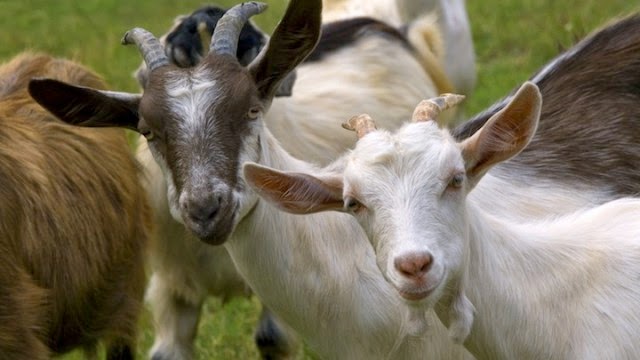
The Benefits of Raising Goats


You get a lot from keeping goats. Raising goats can help you achieve a sustainable lifestyle. You can milk them or eat their meat, use their fiber and their skin for making clothing, and even use their dung for fuel (if you are so inclined).


You may want to raise goats for a variety of reasons:

Becoming more self-sufficient: Goats can give you milk to drink and food to eat, and even help you carry your belongings when backpacking.

Cutting your dairy bill: If you raise dairy goats, you might not have to buy cheese or milk ever again. Your goats need to have kids to give you milk, and then you can milk them throughout the year for up to three years without re-breeding.

Raising your own meat: Goat meat has always been popular in the developing world because goats are much more affordable and use fewer resources than animals such as cows. According to the U.S. Department of Agriculture, the demand for goat meat is expected to continue growing.

Growing your own fiber: Some of the finest fiber comes from goats: Angora and Pygora goats produce mohair, cashmere goats produce cashmere, and crosses between the two breeds produce a fiber called cashgora.

If you raise fiber goats, you can spin your own yarn and make hats, blankets, sweaters or other products. You can also sell the fiber to spinners or to companies that make these products.

Harnessing goats' power as living weed whackers: Goats are well-known for their ability to wipe out weeds. In fact, some people have made businesses out of renting out their goat herds to cities and other municipalities to clean up areas that are overgrown with weeds or blackberry bushes. These leased goats decrease the need to use herbicides, improve the soil's fertility, decrease the risk of fire, increase the diversity of plants in the area, and control weeds in hard-to-reach areas, such as steep hills.

Breeding and selling: Unless your goats are just pets or brush eaters, you probably want to breed them. If you have dairy goats, you need to breed them to keep a good supply of milk flowing. And you need to replace any goats you sell or slaughter.

Keeping goats as pets: You can leash train goats and take them on walks throughout the neighborhood or around your property, which provides exercise for all of you.

Using your goat for packing: Goats are social animals and, after you establish a relationship with them, they love to spend time with you. They enjoy going for hikes and can carry your belongings; they find plenty to eat right there in the wilderness.

Raising goats as a 4-H project: Getting children involved in raising goats is a good way to teach responsibility. Keeping goats requires twice-a-day chores. Children quickly learn that the goats depend on them. They also find out about the cycle of birth and death and get outdoors to get regular exercise.

Tuesday, May 6, 2014

Biggest dog and smallest dog in the world

Giant George the Great Dane, who's almost 5 years old, measured 3 feet 5 inches from the ground to the top of his shoulders, and 7 feet 3 inches from his tail to his nose. On the other end of the canine spectrum, Boo-Boo the Chihuahua measured only 4 inches tall and 6.5 inches long.

George is so large, owner Dave Nasser and his wife, Christie, have to be careful to make sure he doesn’t walk near their 1-year-old daughter Annabel because she’s too little.

“He eats about 110 lbs a week,” the dog’s owner, Arizona-based real estate investor Dave Nasser, said.

That’s the equivalent of 30 Nathan’s hot dogs, an official from the Guinness Book of World records pointed out. At 245 lbs, he weighs as much as the average New York Giants football player.


In a stark contrast, Boo-Boo, at 1.5 lbs., is smaller than a slice of New York pizza.

When the tiny toy Chihuahua was born from C-Section, she was a third of the size of the other puppies, said owner and Kentucky resident Lana Elswick, a former Chihuahua trainer.

“She’s lucky to be alive,” Elswick said about 4-year-old Boo-Boo, who has been record-holder since 2007. “She weighed less than an ounce. I had to feed her from an eyedropper because she was too little to nurse.”

The two dogs may be different, but both seemed equally confused at the Guinness Book of World Records event.

“George is really smart, but I think that it even took him a few minutes to figure out that Boo-Boo was a real dog,” Nasser said.

Thursday, April 10, 2014

How to Raise Nigerian Dwarf Goats

 Nigerian Dwarf Goats are miniature, sweet and easy to keep. Let's go over the basics.


1. Food is important. A good recommendation is to feed the goats Eastern Grass Hay, or Alfalfa mix. Note: If you have wethers and Bucks, that are older, do NOT feed Alfalfa, as it can cause Urinary Calculi. You can also feed kids (0 days-12 month old goats) COB (Corn Oats and Barley) and some Calf Manna. A good place to start is to feed the babies a mix of 2 cup COB and 2 cup Calf Manna, and give them each get a cup of the mix. These are just example measurements, so do research!

2. Have fresh hay as a free choice. You can also have a salt-lick block as free choice. Above all, you need fresh, cold and clean water!

3. Think about a shelter for cold, winter nights even if it's summer.You must clean or "Muck" out where they stay at least every day. Shelters that can be enclosed so that nothing but air and light can get through is ideal. Small babies are easy targets for coyotes. Make sure it's warm, dry and comfy so when the weather gets harsh, you are ready.

4.  Care products. If anything goes wrong, you'll have the supplies.

5. Make sure to have enough feed, water and space for as many goats as you are keeping. Only so many acres can support a goat. You don't need spacious acres with lush green pasture and browse running miles long, you just need a pasture, a shelter, nutritional supplies, health supplies and lots of love and compassion for your little bundle(s) of joy.

Monday, March 17, 2014

8 Benefits of Being a Cat Owner


The war between cat and dog people is vicious and will probably never end. Here’s some ammunition for the next time you're talking to one of those horrible dog lovers.


A study of British pet owners found that people who owned cats tended to be smarter than their dog loving counterparts. Both in terms of IQ score and overall level of education, people who own cats come out on top in the brains department. It’s probably not the cat itself making you smarter, though; the researchers conducting the study said that smarter people tend to work longer hours, and since cats require less attention than dogs they are a better choice for the busy intellectual.

If you're worried about your carbon footprint, it’s better to own a cat. A 2009 study found that over its lifetime, the resources needed to feed a dog make the same eco-footprint as that of a Hummer. Meanwhile, cats—which eat less in general and are more likely to eat fish than corn or beef flavored products—only have the approximate carbon footprint of a Volkswagen Golf.

Losing a loved one is incredibly painful, but one of the best ways of coping is to own a pet. Cats have been shown to help people get over their loss more quickly, and show less physical symptoms of pain, like crying. Despite the fact that they are only animals, cats serve as a social support during difficult times. People in mourning report talking to their pet to work out their feelings, since it is often easier to talk to something that won’t respond and can’t judge than to another human being.

If you’re a single guy and you can’t seem to get a date, get a cat! A British poll found that 82 percent of women agreed they are more attracted to men who like animals. And while having a dog will do wonders for your dating life, a whopping 90 percent of single women said that men who own a cat are “nicer” than other guys. It seems women buy into the stereotype that cat owners are more sensitive and thoughtful, so listing that you own a cat on your dating profile could do wonders for the number of responses you get. But remember, a cat is for life, not just until you find a partner.


Owning any pet is good for your heart. Cats in particular lower your stress level—possibly since they don’t require as much effort as dogs—and lower the amount of anxiety in your life. Petting a cat has a positive calming effect. One study found that over a ten year period cat owners were 30 percent less likely to die of a heart attack or stroke than non-cat owners.


The stereotype that dogs are more affectionate than cats is just that: a stereotype. In fact, it turns out that cats can be just as good companions as dogs, especially for women. A 2003 Swiss study found that having a cat in the house is the emotional equivalent of having a romantic partner. As well as initiating contact much of the time, studies have shown cats will remember kindness shown to them and return the favor later.

But cats really do have the upper hand in these relationships. After thousands of years of domestication, cats have learned how to make a half purr/half howl noise that sounds remarkably like a human baby’s cry. And since our brains are programmed to respond to our children’s distress, it is almost impossible to ignore what a cat wants when it demands it like that.


Owning a cat tells people a lot about your personality. While dog lovers tend to be the life of the party, cat owners are quieter and more introverted. However, they score very highly when it comes to how trustworthy they are and how much they trust other people. Cat owners are also less manipulative and more modest.